
It’s been a good two weeks since the festival ended; I would’ve put these out sooner, but writing up the films I watched is taking me longer than expected (go figure). The bright side is there’s still a lot I fondly remember, and there are a lot of entries here I’d recommend checking out.
As usual, we’re going in the order I’d rank them from weakest to strongest. And while this first batch of seven are the most flawed, some have their merits…
– 27 –
Wildcat
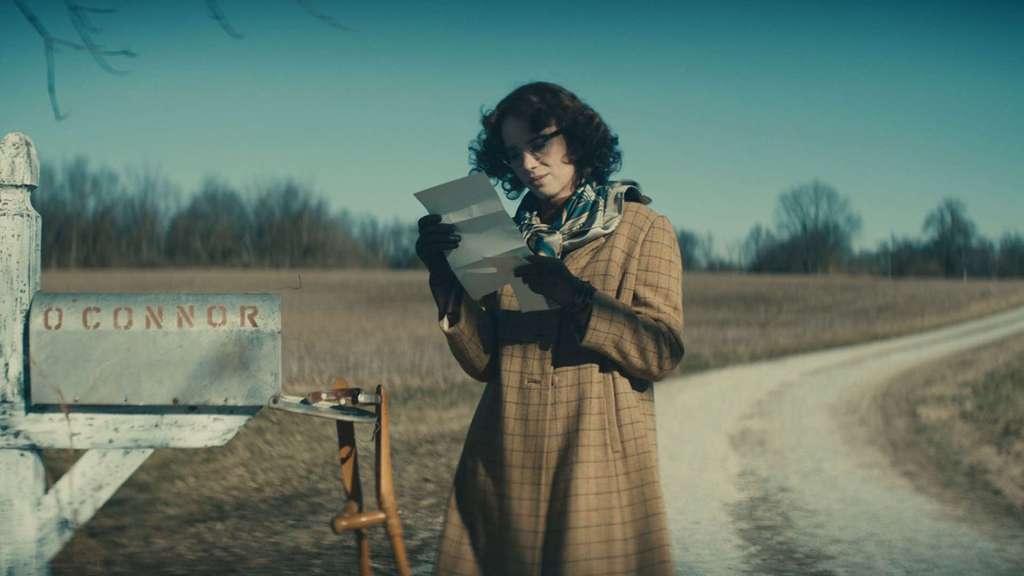
Ethan and Maya Hawke’s admiring portrait of Flannery O’Connor isn’t shy on intentions, following the mid-century author (played by Maya) on the road to completing her first novel in the heart of the American South, and depicting that period’s attitude towards race, religion, and gender with little forgiveness. The biographical experiences have a charged sentiment to the telling, later intercut with brief adaptations of O’Connor’s stories to underscore her view of the times (and the many remnants of it today), but although this works fine on paper, things become uneven in the embellishments. Both the script and performances are keen to picture O’Connor foremost as a creative artist, lending a somewhat discordant, larger-than-life verve to her writerly enthusiasm and process, and while this could add a dose of aspirational relatability (there’s even an emotionally-awkward unrequited romance), it creates tonal overlap when we see her convert the figures from her life into fiction; both parallels have a similar forceful rhetoric and desaturated color scheme, and that lack of contrast (there are delineations, but too minor to be felt) only brings out the unnaturalism of these choices. The author’s prose strove to put truthfulness on the page, but Wildcat instead glazes the past with a fictive shell, softening the ugliness of what’s on screen and undercutting the significance of what we’re witnessing.
– 26 –
Seven Veils
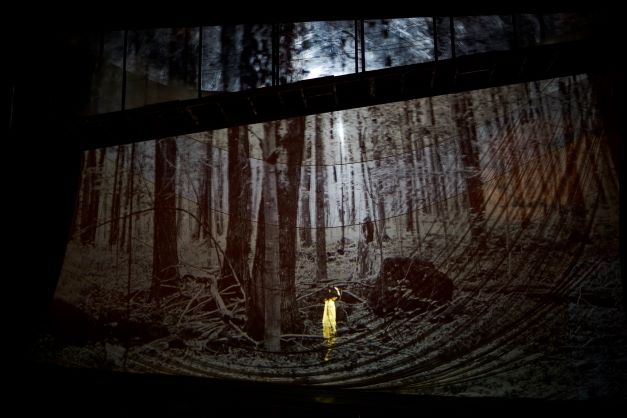
I’d love to call Atom Egoyan’s film a frustratingly flawed experiment, but to be honest, I’m still a little mystified by what it’s meant to be. Amanda Seyfried stars as a director staging a new production of Richard Strauss’s Salome, having previously worked on it decades ago under a now-absent former mentor – who very likely traumatized her behind the scenes (the specifics are undisclosed, but enough implied), and who now haunts both her conscience and, it seems, the production itself, as history repeats through a slew of incidents among the cast and crew, set at a grandiosity that might match what’s being put on stage – though in a way that grows to be more grating than diverting. Seyfried’s director in particular becomes so cringe-inducingly, incessantly problematic that it sours our ability to engage with her issues, which become something for us to sit through between the superb moments we see of the actual opera, masterfully shot by Egoyan, who magnifies its voices and images with intimate understanding. Which shouldn’t be a surprise; Egoyan in real life has helmed this interpretation of Salome for over twenty years, and the talents and stagecraft we see here are those from his most recent production. I’d like to say that he should have just filmed a proper adaptation, but with so much attached to the real-life property, I can imagine why he wouldn’t; and though he claims that the story we do have is one he needed to tell – from which I can only guess at the reason – all it did was make me want to see Salome. Maybe that’s the point.
– 25 –
Mother, Couch
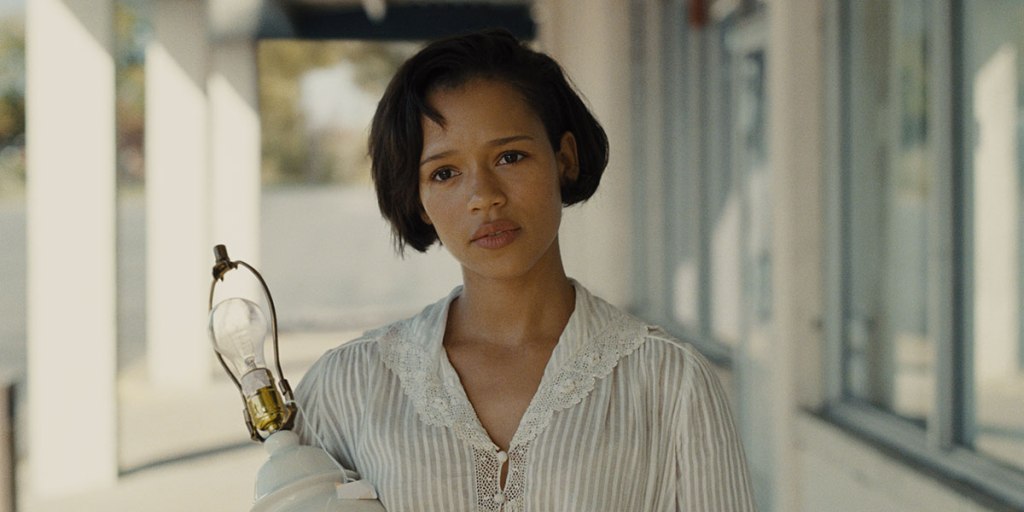
There’s definitely something I should know about Niclas Larsson, who’s followed up a string of short films with a feature that includes Ewan McGregor, Taylor Russell, Lara Flynn Boyle, Ellen Burstyn, Lake Bell, Rhys Ifans and F. Murray Abraham – a pretty striking assembly for a small-scale debut. From the start, this is very evidently a dream-logic-based affair of three siblings grappling with their mother’s influence on them, hellishly represented by an overlong stay at a used furniture store, which means Larson’s dabbling in the territory of more visually-oriented auteurs. To that end, the look is suitably, garishly surreal, with callbacks to everyone from Charlie Kaufman to M. Night Shyamalan to Ari Aster; unfortunately, nothing in the repertoire seems to impress enough to merit the heavy borrowing – nor does any part of the script (which, honestly, would feel better as a short feature) offer enough substance for the obvious metaphors to lean on. The cast is mostly fine, McGregor going for the type of grotesque pitifulness that Joaquin Phoenix channeled more convincingly in Beau is Afraid (though having considerably more time to do so), Burstyn being comically cranky, and everyone else toying with the dreamlike passiveness the setting allows for, with Taylor Russell’s take being the most intrinsic. It doesn’t end much stronger or weaker than it began, and Larsson does demonstrate an economy for establishing rules and language in short space; perhaps next time we’ll get something more inspired than impressionable.
– 24 –
Working Class Goes to Hell
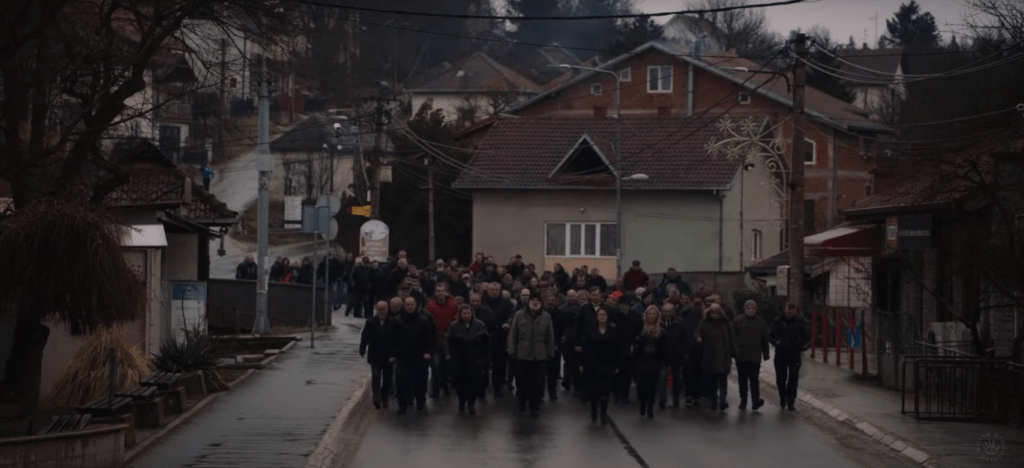
The downtrodden labor union of a small Balkan town reaches the end of their rope, so they turn to Satanism to even the odds and call supernatural vengeance down on the wealthy and corrupt. That’s a genre-bending premise that could go any number of ways, so best to know beforehand that this is far less horror movie and closer to black comedy – and wrapped in absolutely sordid bleakness. The workers are plausibly sympathetic and naively charming, so most of the humor comes from them delving deep into the uncomfortable new rituals they’ve come to practice, and seeing these backfire just as you’d expect, their hardships only getting worse as the upper class continues to take advantage of them. But the consequences are just as grave and cruel as the coldest cinema of the region often portrays, and none of this is even remotely laughed off or treated satirically. By the end, the message is clear and we know where the filmmakers stand, but it can be a pretty grueling path to get there and, even if you can enjoy the mean-spirited irony along the way (as I mostly did, up to a point), any well-meaning declaration comes a bit too late.
– 23 –
Kidnapped
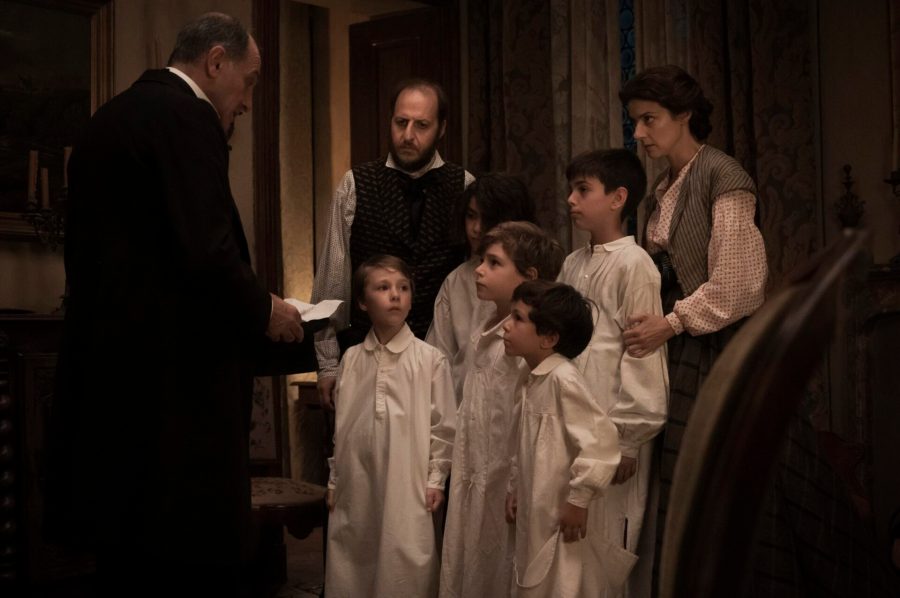
Veteran Marco Bellocchio films a late 19th century account of when the Pope had a Jewish child abducted from his family to be raised as a Catholic, extending to how the backdrop of public perception, the line between Church and State, and political machinations culminating with the unification of Italy made this even more intriguing and complex than it already sounds. That said, there’s an unwieldy number of pieces the film is interested to touch on and not enough time to warrant any proper study, so a lot of the strokes are broad and the melodrama’s laid on pretty thick to get the points across, with brushes of what may be either strange hallucinations or soul-piercing visions to support the sensationalized degree of most events. That could make for tiresome storytelling, and having so many beats eventually does hurt the progression, especially when we reach the inevitable fast-forward and feel like we’ve missed crucial steps in the main character’s growth. Still, the material is undeniably fascinating, the notion of how religious fervor can bewilder and consume even those it strengthens is palpable, and while not spectacular looking, the oil-canvas palette does complete the aesthetic – though I do wish they’d restrained the use of score. This is not essential for sure, but it’s an entertaining enough take on a singular piece of history.

– 22 –
American Fiction
A high-minded black writer (Jeffrey Wright), fed up with the state of the book market, decides to write a novel that panders egregiously to the image of black culture audiences eat up – initially as an angry statement, until his agent sends it off to a few hungry publishers and, well, you can guess what comes next. Although Cord Jefferson’s screenplay (adapted from a novel by Percival Everett) implies a level of absurdity, it’s also clearly prodding the notion that something this ridiculous might not be much of a stretch; there’s even a solid half-hour of set-up to build our goodwill in the film’s grounded-ness, with family and relationship issues that’re familiar but still genuine, and Wright’s timing of course is so naturally perfect that he’s never less than believable. When we reach the comedic conceit, though, the situations (and, yes, the white people involved) are sketched so broadly that I can’t imagine anyone feeling challenged and not reassured by this, especially when the would-be targets are either sycophantic executives or, god forbid, literary judges, and even then the script aims for the (ironically) pandering versions of both. We do once get a character buying into the idea while feeling like a real person, and there’s a similarly intriguing conversation Wright has with another author that goes to interesting places, but these scenes play out in ways that seem to be disingenuously splitting the message – if not trying to have it both ways. I’m sure this sounds more reactionary than warranted (especially as this film won the People’s Choice Award), and Jefferson gives the impression that he means to work in multiple layers, but the conclusion underlines how hollow that effort is, doing away with any earnest development in favor of an escape route from any potential criticism. So we’re left with either a thematic piece that has no discernable thesis, or a high concept comedy without much of a punchline; at least we still have something to laugh at, though, because it definitely isn’t you who’s the butt of this joke.
– 21 –
They Shot the Piano Player
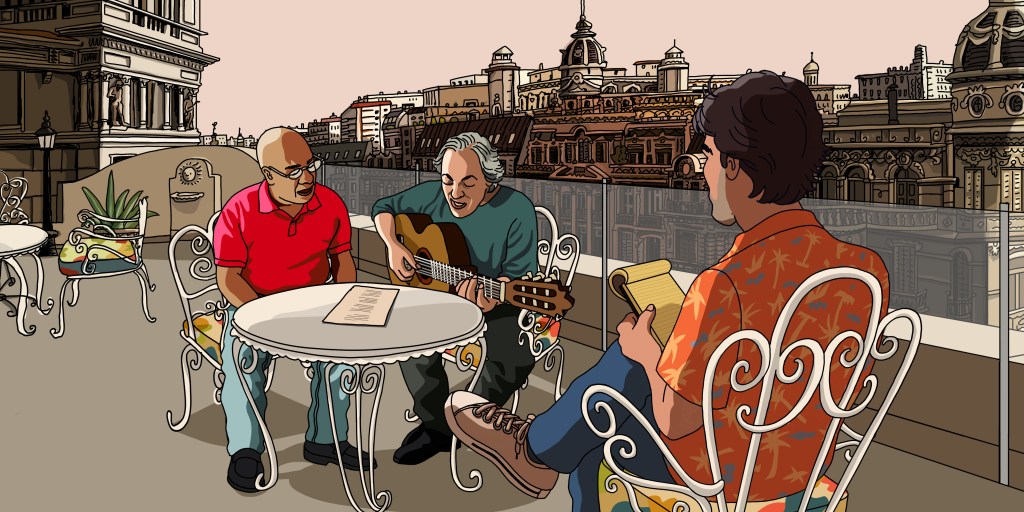
Fernando Trueba and Javier Mariscal’s animated pseudo-documentary, ostensibly about keyboardist Francisco Tenorio Junior (who disappeared during the Argentine revolution), probably has a lot less for movie fans than bossa nova fans, and admittedly I’m in the latter camp. Trueba’s interviews highlight a remarkable collection of musicians I would never have expected to see in this format, and listening to Vinicius de Moraes strumming the rhythm of my all-time favorite song, warmly in concert to memories of the album I fell in love with from my youth, was a thrill. I’m obviously putting more stock here than I probably should, but this is clearly a very personal project for the directors, with the reminiscing a priority and the storytelling a distant second; even the minute design choices – like how Mariscal selects a distinct expressionistic style for each musical flashback, and adjusts the monochromatic hues of these sequences ever so slightly – seem modulated to the feeling these creators want to rekindle in themselves, rather than any specific one they want to stimulate in the viewer. That said, there are too many actual shortcomings to brush aside; the stilted animation (far in quality from Chico and Rita, the duo’s previous collaboration) keeps the flow from fully harmonizing, the decision to swap Trueba’s persona with an American journalist (voiced by a lackluster Jeff Goldblum) is a dud, and the attempt to bridge a full narrative for Tenorio Junior’s tragic story, while noble, falls a bit flat. Somehow, though, I have a sense that these were lesser concerns for the filmmakers, and the rare audience who can get into their groove might just feel the same.
All right, now we’ve reached the group with a definite step up in quality, and I’d gladly vouch for any of these next five that might pique your interest…
– 20 –
NAGA
I shouldn’t be thinking of Western influences here, but Meshal Aljaser’s grungy debut feature reminds me of early Sam Raimi (or Peter Jackson of the Bad Taste era, if you will) merged with the Safdie Brothers; some dizzying handheld camerawork, edited in the style of guerilla horror, creatively displaces our awareness and sensation, which folds into how the plot heightens the urgency (and uncertainty) of keeping time, and how the scoring and sound-mixing cue us into the eeriness of this fever-dream version of Riyadh. To the film’s credit, though, none of its engineering is distracting (and, if you’re on its wavelength, often gets delightful) whether or not you think of how much mileage it’s grinding out of pretty barebones foundation, and a key element here is Adwa Bader, whose workhorse performance puts relentless physicality into a teenager trying to get home before curfew – which means facing an episodic trial of bizarre personalities and obstacles in the pitch black dunes. Easily the most memorable of these is the titular demonic camel who becomes her nemesis, and though I get the constraints (the film’s budget only accommodated a handful of VFX shots, with both puppetry and a real, albeit untrained, camel used for the difference), it is kind of unfortunate that said monster doesn’t get more screentime, as it’s never quite as much fun when it isn’t the focus. Thankfully, while it may all start to feel repetitive towards the tail, the best does turn out to be saved for last in a grisly, bemusing climactic moment, one that at least comes close to the iconic cult cinema it could aspire to.

– 19 –
Holiday
As far as you get from movies it shares a title with, Edoardo Gabbriellini’s film revolves on a murder trial in Italy, but sidesteps the procedures and dramatics to focus on the ambiguous profile of a young woman, drawn with intended mundanity (Margherita Corradi hadn’t even considered acting before this role, and was cast by Gabbriellini through a chance encounter), who is somehow viewed as being of lower-class than her superficially statuesque, classically beautiful, and domineering (and maybe demeaning) mother (Alice Arcuri) – the very person she is suspected of murdering, which has left her ostracized from society even after the law gives her the benefit of the doubt. The film plays a very long game, with dueling narratives at opposite ends of the unseen killing – one set long before, and one long after, yet both taking their time in putting together a clear enough picture around the murky incident and its fallout. The character sketch does follow through on its purpose, and the script, while playing close to its chest, is fair in keeping most of what we see as relevant to both the case and the theme; I’m not fully sure if the narrative gains anything by pacing the exploration out for as long as it does, but the core critique, of how we allow those on the public stage to be judged by how the glamorous perceive them, is delivered with provocative sobriety.
– 18 –
Four Daughters
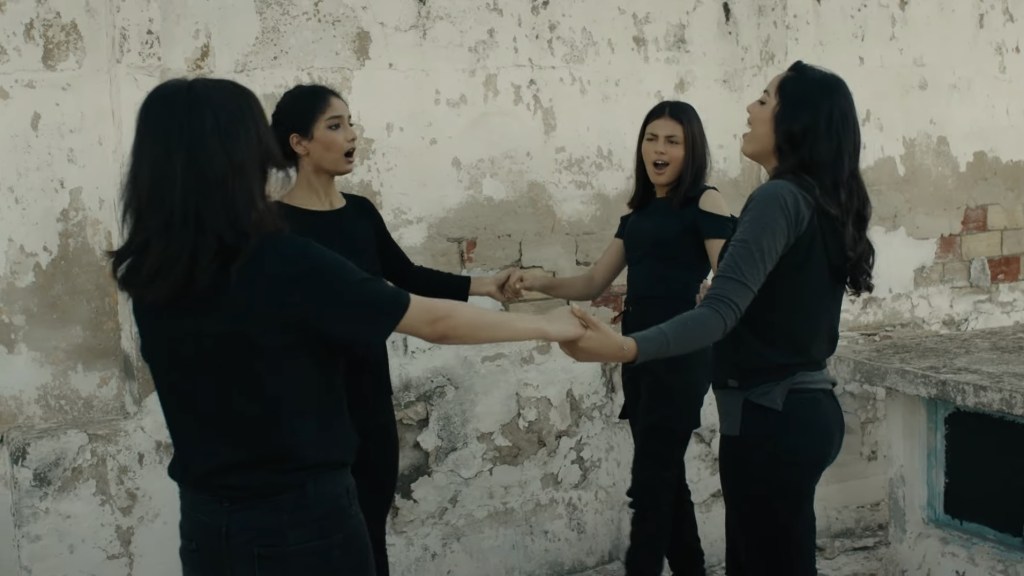
Kaouther Ben Hania returns to the docudrama format with a Robert Greene-esque project, recounting the story of four Tunisian sisters and their upbringing by a strong-willed matriarch. Here she has both professional actors as well as the actual family members share the camera to reenact formative chapters of their histories, in order to help process – and, maybe, shed light on – the tragic circumstances that left them where they are now. Plenty of time is of course dedicated to the preparation sequences, with the filmmaker and performers talking methodically with their subjects as both sides get into character, but this also frequently leads to the family and actors just hanging out and enjoying themselves – often bittersweet, as it’s clear they’re (perhaps unhealthily) leaning a bit too much into using the shoot to relive the life they used to have, as imperfect and problematic as that dynamic was, and not just in the ways you might expect. As the conflicts – and the faults – come clearer into focus, it did surprise me to think of how openly Hania was able to push into such sensitive territory; and even if the matters here are largely on a more personal scale, the perspectives we get feel emotionally authentic, both in the cultural barriers we observe, and in the connections we inherently relate to.
– 17 –
Fingernails
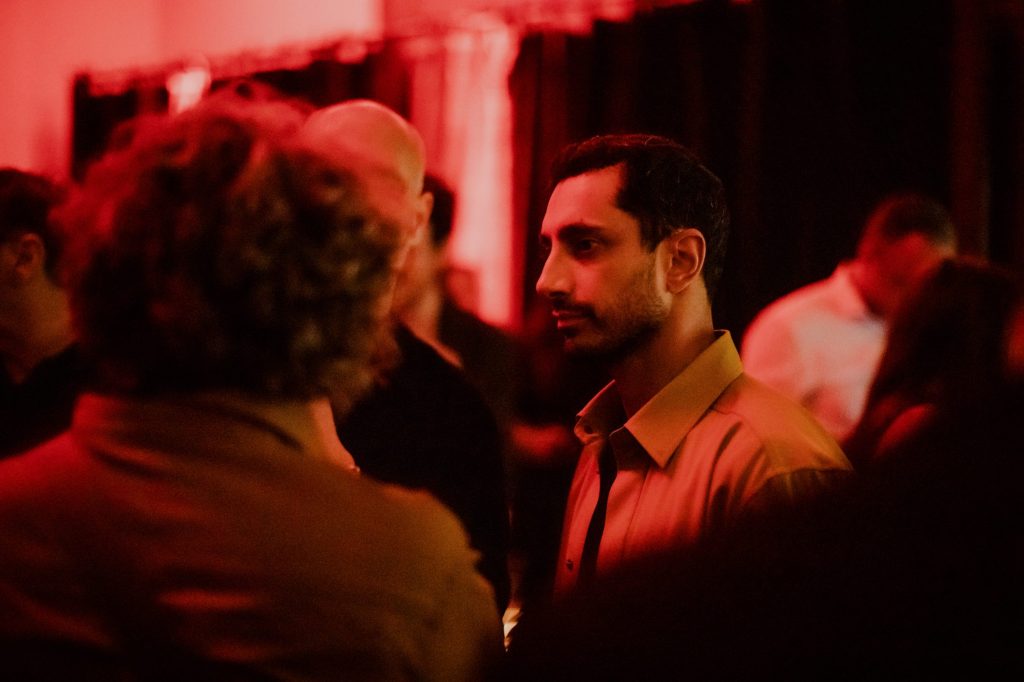
Christos Nikou may still be defining his voice, but he’s so far felt less invested in making artistic or philosophical statements; though his films touch on both of these (and Apples, his first feature, had a particularly twisty way of slicing its narrative), the inclinations have been romantic at heart, and with the straightforward plotting of Fingernails, he continues to succeed through an almost minimalist touch for the kind of affects, quirks, and delicate music that aims to induce rather than impress. It could at times feel like he’s working through broad shortcuts or triggers, and that might recall this film’s premise; a seemingly-scientific test has been developed to determine whether or not two partners are “in love”, and we follow a pair of educators (Jessie Buckley and Riz Ahmed) who mentor participants on how to raise their chances of testing positive. Although the film may not be interested in asking questions, or in showing off its causal world in quick non-sequiturs, nothing’s stopping us from mentally inquiring on our own; like why some people react to the paradigm by recontextualizing biblical stories, or how intensely vulnerable experiences are meant to improve one’s “love score”, or if the science behind such a reductive test is as flimsy as the mystery-microwaves that empower it – or, yes, just why fingernails exactly, per the most succinct of Nikou’s gags. Instead, the film is more concerned with Buckley (who, for the record, I think is very good here) and the vulnerability she herself is now exposed to; and while that means things could depend on whether you feel there’s chemistry between her and Ahmed…then you think back to the premise, and maybe there’s more to inquire after all.
– 16 –
The Holdovers
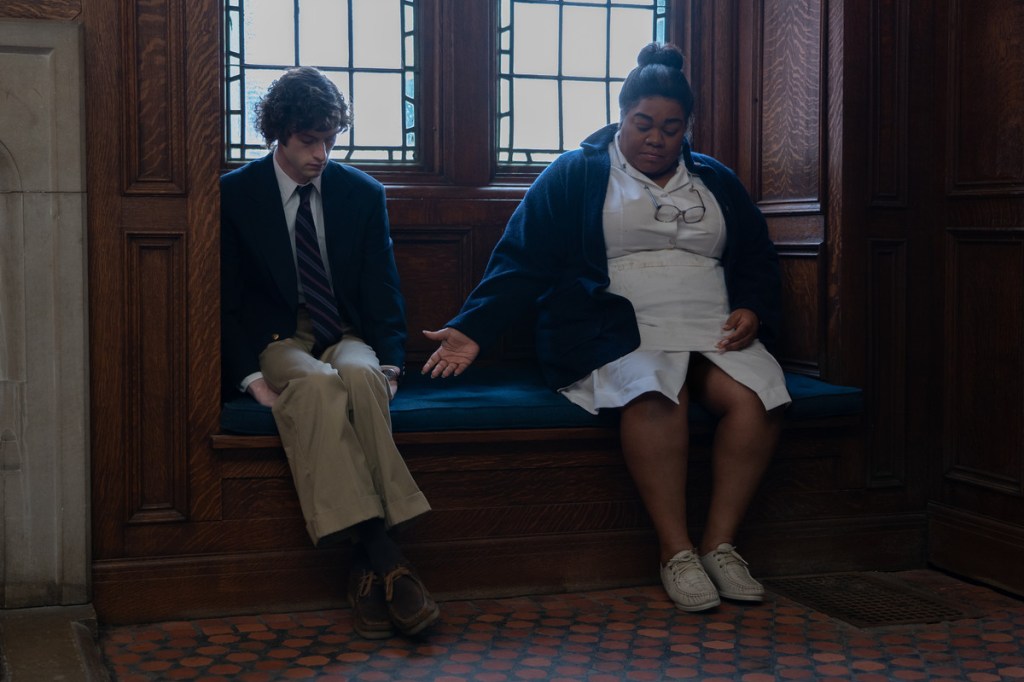
It’s a warm crowd-pleaser of a script, complete with a sprightly first act, pointed clarity in its morals, and an overlong denouement that ensures you’re not left in the cold. But it’s also tight and well-paced, rarely boring in its structure (the dynamic changes quite frequently, almost conscious of any drag), and witty throughout – plenty of that coming not just from the history teacher played by Paul Giamatti, since both his delinquent student (Dominic Sessa) and kitchen-working colleague (Da’Vine Joy Randolph) get plenty of great material, and Randolph especially brings depth to the role while making it look easy. Moreover, director Alexander Payne isn’t trying to hide the Christmasy trappings here: the dewy-eyed lens brings hominess to the stately boarding school location while recalling generational memories of the season’s programming, so though it may be predictable, I can’t fault how any scenes that go into discomforting territory remain cushioned by a sentimental purity, or that the friction between characters never has any real bite. What matters is that Payne and writer David Hemingson use these tools to dredge up the humanity of what they’re probing: the pain of what it’s like not just to be left behind, but to be unwanted or displaced by the people and things who’ve given you a semblance of home and peace, and I appreciate the obvious but needed effort on the inclusiveness of that message (even Giamatti’s character is slowly revealed to have much sketchier origins than we may have guessed – though again, the film doesn’t dirty itself by dredging this up too much). To that end, toothless as it is, The Holdovers is a more than pleasant couple of hours that may just bring a cozy feeling to anyone lonely over the holidays, and I don’t think there’s any better praise for it than that.
One last break for now to call out this next set, which may rank just outside the top ten, but all have something special to them …

– 15 –
Hit Man
It’s easy to get what drew Richard Linklater and Glen Powell to this off-the-wall, weird-yet-true Texas Monthly story, as the premise makes for too good a pitch to pass up: a timid philosophy professor (Powell) discovers a talent for impersonating assassins and conning would-be criminals, which brings more than a bit of wish-fulfillment and a meeting with a beguiling woman (Adria Arjona) who wants to hire him. But unlike how Linklater’s Bernie (based off similar source material, both written by Skip Hollandsworth) mostly stuck to the facts, here the actual Hit Man article takes us just as far as the first act, leaving the remainder to extrapolate (or maybe improvise) how a more fateful version of events could’ve occurred, if only they were punched up by the coincidences, unlucky breaks, and narrowed universe that ensures these incidental players somehow keep smacking into each other’s orbits – the spirit of what makes star-crossed comedies so much fun. That affection for genre isn’t a secret; Powell’s character drops more than a few allusions in his method-acting shenanigans, but more tasteful are the interactions between him and a very game Arjona, who matches (and sometimes surpasses) his exuberance to homage the sex-romps and screwballisms of Hollywood gone by, speaking to how desperate these two are for something more exciting than their current baggage permits, and to how much the creators miss the spiciness that on-screen romance used to have when its pursuits were so much freer. All of this would’ve been enough for Linklater and Powell to rest their pens on; they’re too much of professionals for that, though, and as the steaminess slowly relaxes our grip on what’s believable (or truthful), so too do the stakes get higher, the situations zanier, and the margins blurrier between slapstick comeuppance and very morbid danger – until we hit the mark that fully invites us to leave our rules behind, and embrace our inner hedonism for the macabre pleasures that only movies can get away with.
– 14 –
Together 99
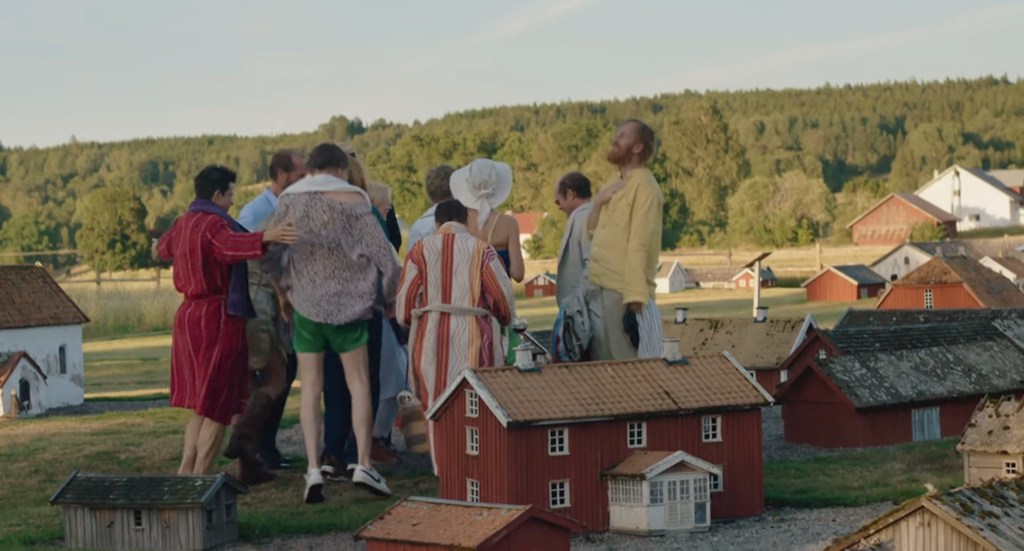
I’m sure even Lukas Moodysson fans were surprised to learn he’d written and directed a follow-up to Together (one of his earliest films, about people inhabiting a commune in ‘70s Stockholm); well, right off the bat he seems to acknowledge just how ridiculous – and desperate – it was to go back to these characters in the first place, throwing away the impetus for their in-story reunion with cheeky abandon, let alone any reasoning or reintroduction for the uninitiated. At times, the sequel almost feels at odds with the attitude of the original, which used its observational shooting style, the cultural mores of its decade, and adolescent viewpoints to somewhat anchor its satire of the commune’s ideologically (and socially) underdeveloped adults; this time almost all of those elements are let loose for a comparatively absurdist, technically loftier (the Tillsammans house and surroundings are themselves loaded with much more sardonic character), and hilariously disastrous view of people who (more than twenty years later) still never fully formed into the idea of what they may have thought they were, in a turn of the millennium period that itself feels arrested and disappointed, and Moodysson rolls with that damning suggestion to stretch and ply each familiar face from their resigned composures to emotional and mental breaking points (sadly fitting, then, that the characters from the original who don’t return are those whom, frankly, were better molded for the future from the get-go). While that makes for a different experiment than before, the trademark pathos in the analysis is still there, and just as the first film ended with the commune finding tenuous solace in each other’s immaturity, amidst the apathy of an outside world, so too does Together 99 find them (and Moodysson) holding on to comforts that may be just as abstract, absurd, and illogically desperate, if only to make sense of the downhill years they probably have ahead.
– 13 –
How to Have Sex
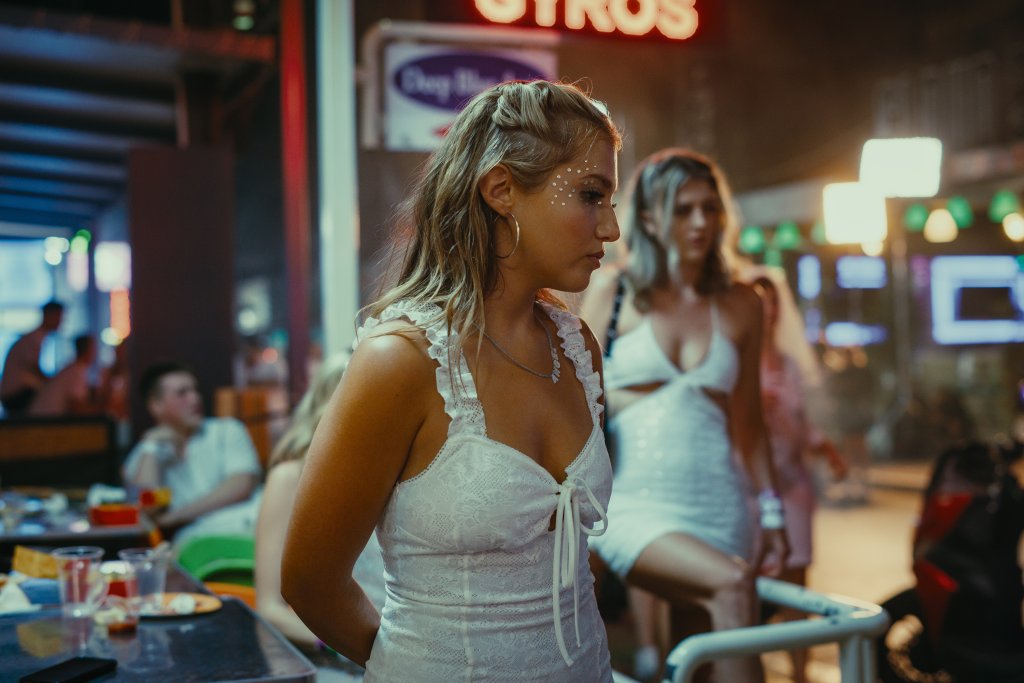
The subject matter’s come closer and closer to the fore in recent media, but it’s all about the execution here; other debut filmmakers might prioritize establishing their visual or rhythmic identity, but Molly Manning Walker’s selfless approach gives the whole film over to her protagonist (a fantastic Mia McKenna-Bruce), in what begins as a typical coming of age story of three girls craving to make the most of a raucous weekend at the beach. There are flourishes to the cutting (an early introduction to a character and dynamic by flipping perspective in a conversation across balconies is simple and meaningful), a few vivid indulgences of tourist-sullied locations, and some massive party set-pieces that amplify our unease through noise and imagery (the use of extras and ephemera are spot on) without falling into psychedelia. Yet Walker refrains from overreaching her hand to illustrate what her lead is thinking; instead, she confidently allows for the shielded internal performance to have its own agency – and, critically, to carry the film’s chilling turning point, which hits in a shockingly austere moment. And suddenly it’s clear that our intake of all the on-screen libido has hinged not on the atmosphere, but on McKenna-Bruce’s careful unraveling beneath an unfazed exterior, speaking to how real-life situations don’t cue us in to the horrific and ugly abuse that can be happening in front of our eyes. It’s made me think if the title is appropriate, given the eventual irony in a film that isn’t really ironic; maybe it’s a caution to how dismissively we regard what seems meant to titillate, and how little thought we give to the consequences on the other side.
– 12 –
His Three Daughters
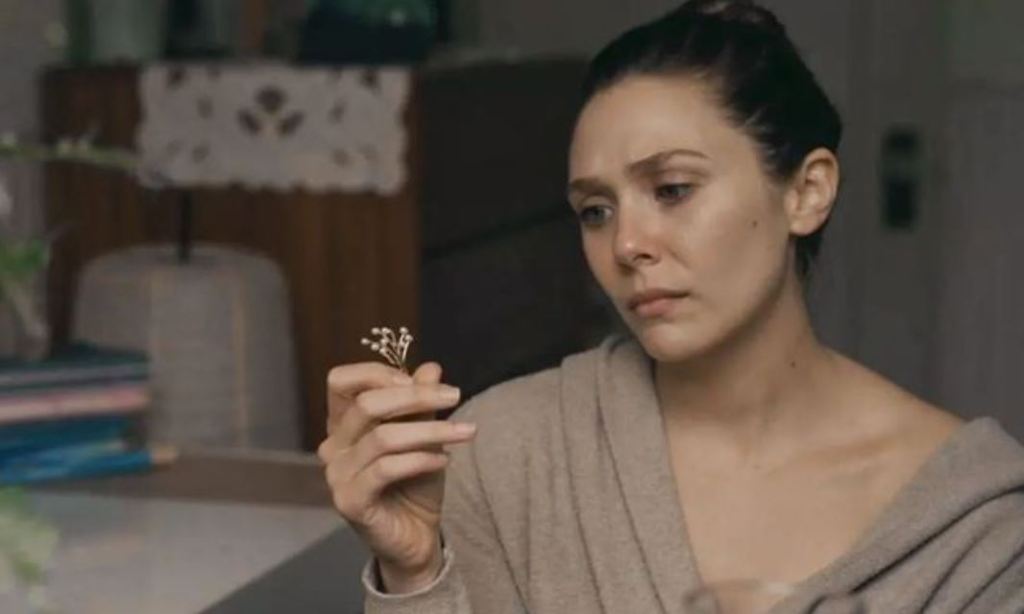
The dramatic levers may feel overworked at the outset, beginning with a father on his deathbed, his adult children (Natasha Lyonne, Carrie Coon, and Elizabeth Olsen) brought together to keep watch as they count the hours, and some convenient expositional dialogue to get us up to speed. But the construction of Azazel Jacobs’s film eventually rewards in its restraint, the object of grief literally removed from the spotlight with only the barest sentimental references in the dialogue, as the sisters occupy themselves with the present and afford few subjective words to memory. Likewise does the structure forego the tease of a slow-burn formula, or a build-up to moments of revelation or recontextualization; instead it falls on the purer approach of Jacobs honing to the steady interplay of characters against each other as they unpack their egos, the predicament and created proximity bringing their damaged personalities and strained relationships into focus, given just a bit more edge from the spare lighting, muted colors, and breaks from the editing’s steady pulse into short-lived bursts of tension and anxiety. Yet there’s also a good bit of levity, the arrangements often stifling the characters but allowing them to breathe when they need to, and Lyonne is especially exceptional at keeping her hazy behavior in empathetic balance, centering the film’s suggestion that we view each sister from multiple angles and heed the quiet complexity that textures each tiny confrontation (and all the micro aggressions involved). This culminates in a segment that I could almost feel was studied from Bergman’s later dramas, wherein the narrow corridors of the house that seem to be the bridges and divisions of the sisters’ conflict become the stage of contention, bringing a moment of oppressive blocking and shadow to bear on pent-up feelings that finally fray the air. That could all sound pretty morose; Jacobs may have felt so too, and with the last act comes what feels like just a bit of compromise, the objective reality loosened ever-so-slightly to soften the inevitable blow with some unexpected, but perhaps needed sincerity, and allowing us – if not these characters – a shred of resolution to such carried pain.
– 11 –
La chimera
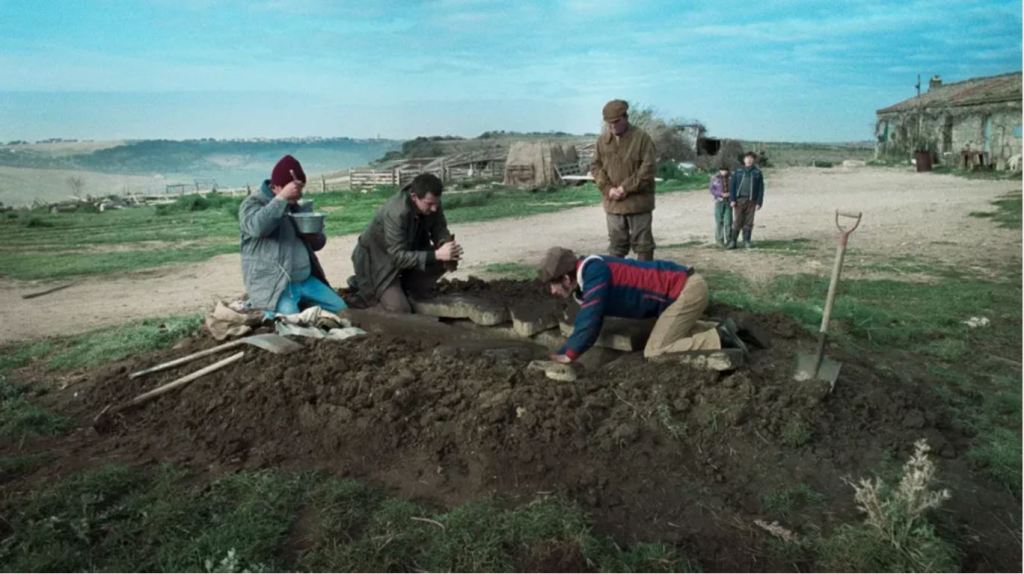
Alice Rohrwacher’s latest introduces a British archaeologist (Josh O’Connor), the archaic family estate that’s adopted him (consisting of Carol Duarte and Isabella Rossellini), and the merry band of misfit grave-robbers he leads through a preternatural gift for locating the Etruscan tombs buried throughout the Italian countryside, to make a living off selling the property of the long-dead to rich collectors. It’s a fable that summarizes the ideas Rohrwacher and her new wave contemporaries often revisit, about people motivated to recover and recycle what’s become outmoded and forgotten, and cinematographer Helene Louvart accentuates that essence more potently than before, the grading and roughness of her tapestry instilling a visceral, rustic antiquity to the tale; still, for all the classicism, it also seems to me that Rohrwacher approaches her work with more curiosity – if not irreverence – than most, especially in how she’s come to more playfully toggle the dials of time and space in her filming and editing, whether by suddenly dropping frames to add whimsy to what would be a laborious sequence, or vertically looping the camera as a slap to the face in light of the silliness you’ve just seen.
That said, though I wish I could say her style kept me as invested as usual, I admit to having difficulty with O’Connor’s protagonist, a man emotionally vacant and detached by design in order to be as effective as he is at what he does, so much so that what waylays him from the ultimate artifact he seeks (a door to the afterlife, for reasons as dour as you can guess) is when Duarte’s character (literally named “Italia”) begins to reawaken the vivacity and connection he has for the land above, and while I can’t fault the performance (Rohrwacher initially conceived an older character than O’Connor’s, and I hate to say it, but that might have fit better), there’s something missing in not being able to warm to him as we can to everyone around him; it’s felt especially as his emptiness drives the extended midpoint, wherein the rest of the cast becomes more of set-dressing and the colorfulness fades into a drier literalism. Luckily, things do get more of a kicker in the last quarter or so, as poetic turns resolve the various relationships in ways you might not expect, leading to a perfect, if predictable, picture to end on. This remains a showcase of Rohrwacher’s puckish lyricism and haunted imagination, odefully mourning for beauty the world has lost and the mind can’t bury.
 flies on the ceiling